
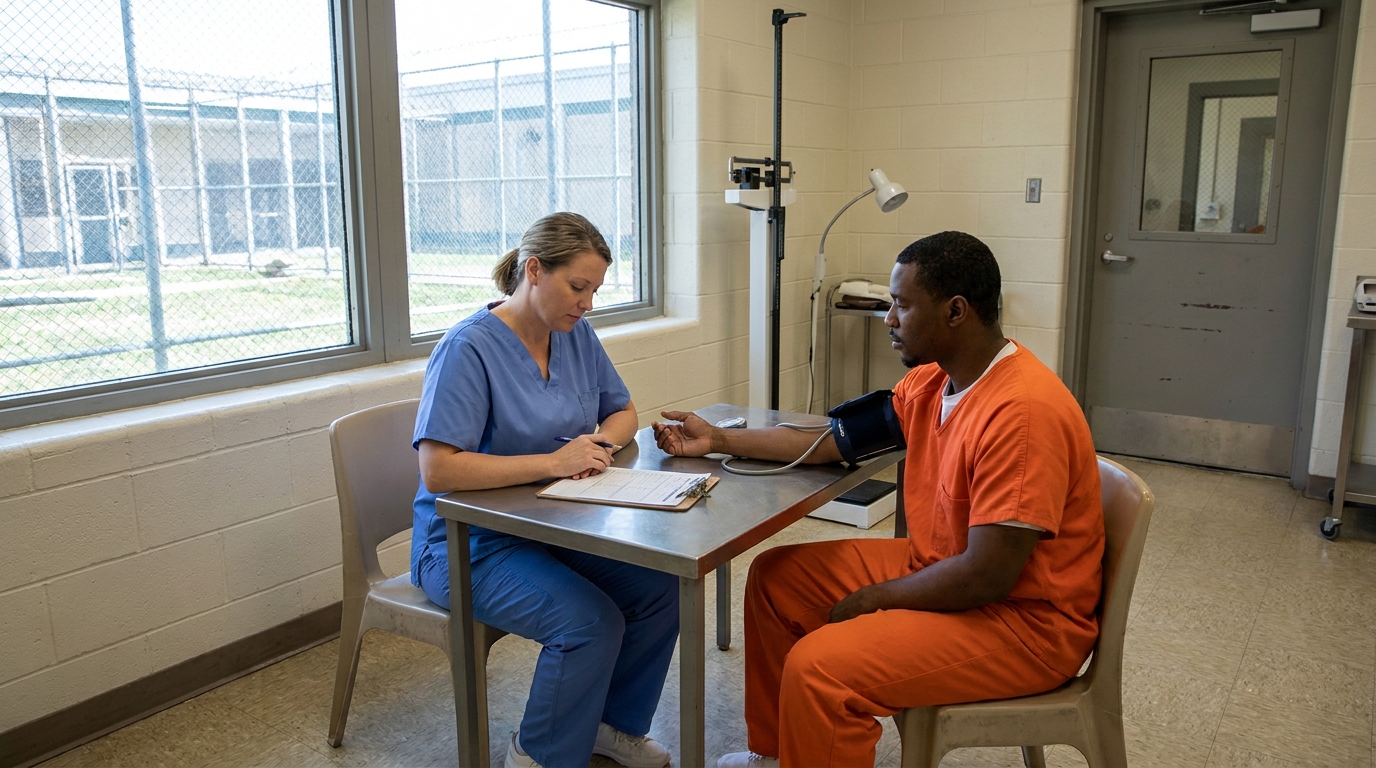
Key Takeaways
- Medical intake screening begins at booking and must identify emergencies, withdrawal risk, and suicide risk before an individual enters general population housing.
- NCCHC standards require two levels of screening: an initial health screen within hours of arrival and a comprehensive health appraisal within 7 to 14 days for individuals remaining in custody.
- Alcohol and opioid withdrawal are among the most life-threatening conditions seen at jail intake, and validated clinical tools such as CIWA-Ar and COWS guide staff response.
- Medication continuity is one of the most common points of failure at intake, and robust programs use verification protocols and standing orders to prevent dangerous gaps.
- Courts have held since Estelle v. Gamble (1976) that incarcerated individuals have a constitutional right to adequate medical care, making thorough intake screening both a clinical and legal obligation.
- Specialized correctional healthcare organizations bring pre-built protocols, trained staff, and compliant documentation systems that support consistent, auditable intake screening.
Table of Contents
- Why Medical Intake Screening Matters in Jails
- The Core Components of a Jail Medical Intake Screening
- How Staffing and Clinical Oversight Shape the Process
- Common Challenges in Jail Intake Screening
- How Intake Screening Connects to Long-Term Health Management
- What Families and Attorneys Should Know
- Frequently Asked Questions
Medical intake screening in a county jail is a structured clinical process that identifies health risks, acute medical needs, and mental health concerns for every person booked into custody. It typically occurs within hours of arrival and is designed to protect the safety of the individual and the broader jail population. Protocols are guided by standards from organizations such as the National Commission on Correctional Health Care (NCCHC) and the American Correctional Association (ACA). When executed correctly, intake screening reduces medical emergencies, prevents communicable disease spread, and ensures continuity of care from the community into custody.
Why Medical Intake Screening Matters in Jails
County jails receive a uniquely high-risk population. Studies published by the Bureau of Justice Statistics consistently show that people entering jail have disproportionately high rates of chronic illness, substance use disorders, mental health conditions, and infectious disease compared to the general public. Many arrive in medical crisis, in active withdrawal, or without access to prescriptions they depend on daily.
Unlike prisons, which house sentenced individuals for longer periods, jails book and release people continuously – sometimes within hours or days. This rapid turnover makes structured screening essential. Without it, a person in diabetic crisis, opioid withdrawal, or acute psychiatric distress can deteriorate quickly in a holding cell.
Medical intake screening also carries legal weight. Courts have consistently held, beginning with Estelle v. Gamble (1976), that incarcerated individuals have a constitutional right to adequate medical care under the Eighth Amendment. Failure to screen and treat can expose a county to serious civil liability.
The Core Components of a Jail Medical Intake Screening
A complete intake screening is not a single form – it is a layered process with multiple timed checkpoints. The NCCHC standards, widely adopted by accredited facilities, describe at least two levels: an initial health screening and a more comprehensive health appraisal.
Initial Health Screening (Within Hours of Arrival)
The initial screen typically happens at booking, often performed by trained correctional officers or intake staff using a standardized protocol, and escalated to licensed clinical staff when a concern is flagged. It covers:
- Current medications and chronic conditions. Staff ask about diabetes, hypertension, seizure disorders, HIV, asthma, and other ongoing diagnoses. Verification of medications is a priority because abrupt discontinuation of some drugs – such as antiepileptics or blood pressure medications – can be life-threatening.
- Substance use and withdrawal risk. Alcohol withdrawal and opioid withdrawal are among the most dangerous conditions seen at intake. Tools such as the Clinical Opiate Withdrawal Scale (COWS) and the Clinical Institute Withdrawal Assessment for Alcohol (CIWA-Ar) help staff objectively measure severity and determine whether medical management is needed immediately.
- Mental health indicators. Staff screen for suicidal ideation, recent psychiatric hospitalizations, and signs of acute psychosis. Suicide is the leading cause of death in U.S. jails, according to the Bureau of Justice Statistics, making this portion of the screen critically important.
- Communicable disease exposure. Questions about tuberculosis symptoms, sexually transmitted infections, and recent illness help identify individuals who may need isolation or further testing to protect the rest of the population.
- Visible injuries or signs of trauma. Any injuries noted at booking are documented to establish a medical baseline and to distinguish pre-existing conditions from anything that might occur while in custody.
- Pregnancy. Pregnant individuals require immediate referral and ongoing prenatal coordination throughout their stay.
When any of these areas produces a concern, the intake officer is required to escalate to a nurse or physician immediately rather than waiting for a scheduled appointment.
The Comprehensive Health Appraisal (Within 7-14 Days)
For individuals who remain in custody beyond initial booking, NCCHC standards call for a more thorough health appraisal, typically completed within 7 to 14 days of arrival. This evaluation is conducted by licensed clinical staff – nurses, nurse practitioners, or physicians – and goes deeper than the initial screen.
It includes:
- A full medical history
- A physical examination
- Vital signs and basic laboratory work as clinically indicated (blood glucose, complete blood count, STI testing, tuberculin skin testing or IGRA blood test for TB)
- A mental health evaluation if not already completed
- Dental screening in many facilities
- Review and establishment of a care plan for identified chronic conditions
The appraisal creates a documented medical record that follows the individual through their entire period of incarceration and informs housing assignments, work assignments, and any necessary accommodations.
How Staffing and Clinical Oversight Shape the Process
The quality of medical intake screening depends heavily on who is conducting it and what clinical supervision exists. Facilities with on-site licensed nursing staff 24 hours a day, 7 days a week are better positioned to respond immediately to flagged concerns than those relying on part-time coverage or off-site consultation.
Some county jails manage healthcare internally through county employees, while others contract with specialized correctional healthcare organizations. Third-party providers that specialize in correctional health bring standardized protocols, trained staff, and systems built around regulatory compliance. Organizations such as GENESYS Health Alliance (genesyshealth.net) develop intake screening programs specifically designed for the operational realities of county facilities, including the high volume, rapid turnover, and unique legal obligations jails face.
Key staffing elements that support effective intake screening include:
- Registered nurses (RNs) at booking. An RN can make clinical judgments that a correctional officer cannot, including initiating a withdrawal protocol, calling for an emergency medical response, or placing a person on a medical watch.
- Mental health professionals. Psychologists, licensed clinical social workers, and psychiatric nurses assess suicidality and psychosis with validated tools such as the Columbia Suicide Severity Rating Scale (C-SSRS).
- Physician or advanced practice provider oversight. A medical director or supervising provider reviews protocols, signs off on standing orders, and provides oversight for complex cases identified at intake.
- Clear escalation pathways. The screening process only works if there is a defined chain of communication when a problem is found – from the officer to the nurse to the physician to the emergency room if needed.
Common Challenges in Jail Intake Screening
Even well-designed programs encounter real-world obstacles. Understanding these challenges helps explain why specialized expertise and dedicated resources make a measurable difference.
High Volume and Time Pressure
Large urban jails can book hundreds of individuals per day. Under these conditions, thorough screening can be difficult to sustain consistently. Standardized tools, electronic health records (EHRs) designed for correctional settings, and clearly trained staff reduce the risk that someone with a serious condition is overlooked during a busy shift.
Incomplete or Unverifiable Medical Histories
People arriving at intake may not know their diagnoses, may not have identification, or may be reluctant to disclose health information. Pharmacy verification calls, contact with prior facilities, and cooperation with community providers help fill gaps, but this takes time and coordination.
Behavioral Health and Substance Use Overlap
Many individuals present with co-occurring mental health and substance use disorders – what clinicians call a dual diagnosis. Distinguishing between psychiatric symptoms and the effects of intoxication or withdrawal requires clinical skill and sometimes time for the acute effects to subside before an accurate assessment can be made.
Medication Continuity
One of the most frequent points of failure in jail intake is the gap between what someone is prescribed in the community and what they receive in custody. Verification of prescriptions, especially for psychiatric medications and controlled substances, requires direct contact with pharmacies or prescribers – a process that takes time and resources. Lapses can lead to destabilization, self-harm, or medical emergencies.
Documentation and Legal Accountability
Everything discovered at intake must be documented accurately and contemporaneously. Incomplete records are not just a clinical problem – they are a liability problem. Auditable, time-stamped documentation in an EHR built for correctional use supports both quality care and legal defensibility.
How Intake Screening Connects to Long-Term Health Management
Medical intake screening is the entry point to a continuum of care that extends throughout a person’s time in custody. Information gathered at intake directly informs:
- Chronic disease management programs for conditions like hypertension, diabetes, asthma, and HIV. Identifying these conditions at intake allows clinical staff to establish monitoring schedules and medication regimens before the person’s health deteriorates.
- Mental health treatment plans that address diagnosed conditions, provide therapy, and connect individuals to psychiatric medication management.
- Infectious disease control, including isolation protocols for active TB, treatment initiation for HIV or hepatitis C, and vaccination opportunities.
- Reentry planning. Health information gathered throughout incarceration can support connections to community providers upon release, which reduces the risk that release itself becomes a dangerous health transition.
County jails have become, by default, one of the largest providers of healthcare to underserved and uninsured populations in the United States. A rigorous intake screening process is the foundation on which everything else depends.
What Families and Attorneys Should Know
Families of individuals in custody often have questions about medical care that can go unanswered. A few facts are worth understanding:
Healthcare records generated in a jail setting are protected by HIPAA and state privacy laws in most jurisdictions, with narrow exceptions. Families generally cannot access records without written authorization from the individual in custody.
If a family member has information about a critical health condition – an active prescription, a recent hospitalization, a known allergy – they should communicate that information directly to the jail’s medical unit as soon as possible. Most jails have a medical line or intake process for receiving outside health information. Timely disclosure can prevent dangerous medication gaps.
Attorneys representing individuals in custody have broader access rights in many jurisdictions and can request medical records as part of due process. If a client alleges that screening was inadequate or that a serious condition was missed, an attorney may request intake documentation, nursing notes, and the facility’s written protocols to evaluate whether the standard of care was met.
Frequently Asked Questions
How soon does medical screening happen after someone is booked into a county jail?
In facilities following NCCHC standards, an initial health screening is completed at or very close to the time of booking – ideally within the first few hours of arrival. The goal is to identify emergencies, withdrawal risk, and suicide risk before the individual is placed in a general population housing unit. A more comprehensive health appraisal follows within 7 to 14 days for individuals who remain in custody.
What happens if someone needs medication that they were taking before they were arrested?
Staff at intake are trained to ask about current medications and to begin the verification process as quickly as possible. For life-sustaining medications – insulin, seizure medications, psychiatric drugs, HIV antiretrovirals – most protocols require verification and continuation as a clinical priority. There may be a short gap during verification, but facilities with robust intake programs use standing orders and clinical judgment to bridge that gap when waiting for confirmation would create unacceptable risk.
Can a person refuse medical screening at intake?
Individuals in custody retain certain rights, including the right to refuse medical care in most circumstances. However, many elements of intake screening are also classified as safety assessments for the facility, not just personal medical care. Facilities typically document a refusal carefully and may conduct visual observations even when verbal participation is declined. A refusal does not eliminate the facility’s responsibility to monitor for signs of medical distress.
What is the difference between medical intake screening and a full physical exam?
The initial intake screening is a targeted risk assessment designed to identify urgent problems quickly. It is not a comprehensive physical exam. The comprehensive health appraisal completed within 7 to 14 days is more thorough and includes a physical examination, laboratory work, and a structured review of medical history. Some facilities also provide dental screening at this stage.
How does a correctional healthcare organization differ from a county health department running jail medical services?
Specialized correctional healthcare organizations focus exclusively on the clinical and regulatory demands of the jail and prison environment. They bring pre-built protocols, trained staff experienced in correctional settings, software systems designed for custody healthcare, and familiarity with NCCHC and ACA accreditation standards. County health departments provide excellent community healthcare but may not have the same depth of correctional-specific infrastructure. Organizations like GENESYS Health Alliance (genesyshealth.net) work directly with county facilities to build or improve intake screening programs that meet constitutional and accreditation standards.